Greene County Commissioners Pull Budget From Agenda at June 1st Meeting
Nothing in the weeks of public discussion had suggested unresolved issues with the spending plan. While commissioners had continued asking questions after the workshop, the expectation.....

Monday looked like budget day in Greene County. It wasn’t.
County Manager Kyle DeHaven had done exactly what commissioners asked him to do at the May 27th budget workshop. After receiving the proposed budget less than two weeks earlier, commissioners spent hours working through the numbers, hearing updates on the countywide salary study and personnel policy revisions, debating tax rates, and ultimately sending DeHaven back with instructions to revise the spending plan to include a property tax reduction.
He delivered.
The revised ordinance was in the packet. The required public hearing was scheduled. After a relatively compressed budget cycle between the May 18th distribution of the proposed spending plan and Monday’s meeting, there appeared to be little standing between commissioners and final adoption.
DeHaven arrived at the Greene County Operations Center expecting the county to be approaching the finish line. He remarked to those nearby that he was looking forward to having a little more breathing room once the budget process was finally behind him.
It did not take long to realize the morning was not going according to script.
The first indication came immediately after the invocation, offered by Commissioner Ray Johnson, and the Pledge of Allegiance, when Chairman Bennie Heath asked commissioners to move the closed session from its scheduled position at the end of the agenda to immediately after public comments.
The request was unusual.
Boards of commissioners typically place closed sessions after all public business concludes. Moving it up to the front half of the meeting, before county manager action items and well before the expected budget vote, immediately shifted the tone of the room.
Nothing in the weeks of public discussion had suggested unresolved issues with the spending plan. While commissioners had continued asking questions after the workshop, the expectation entering Monday morning was that adoption would be routine.
The shape of the morning had already changed.
By the time Senior Center Director Sharon Harrison walked toward the podium for the first public information item of the day, some in attendance were already watching the agenda more closely than usual.
Senior Games Bring a Moment of Celebration
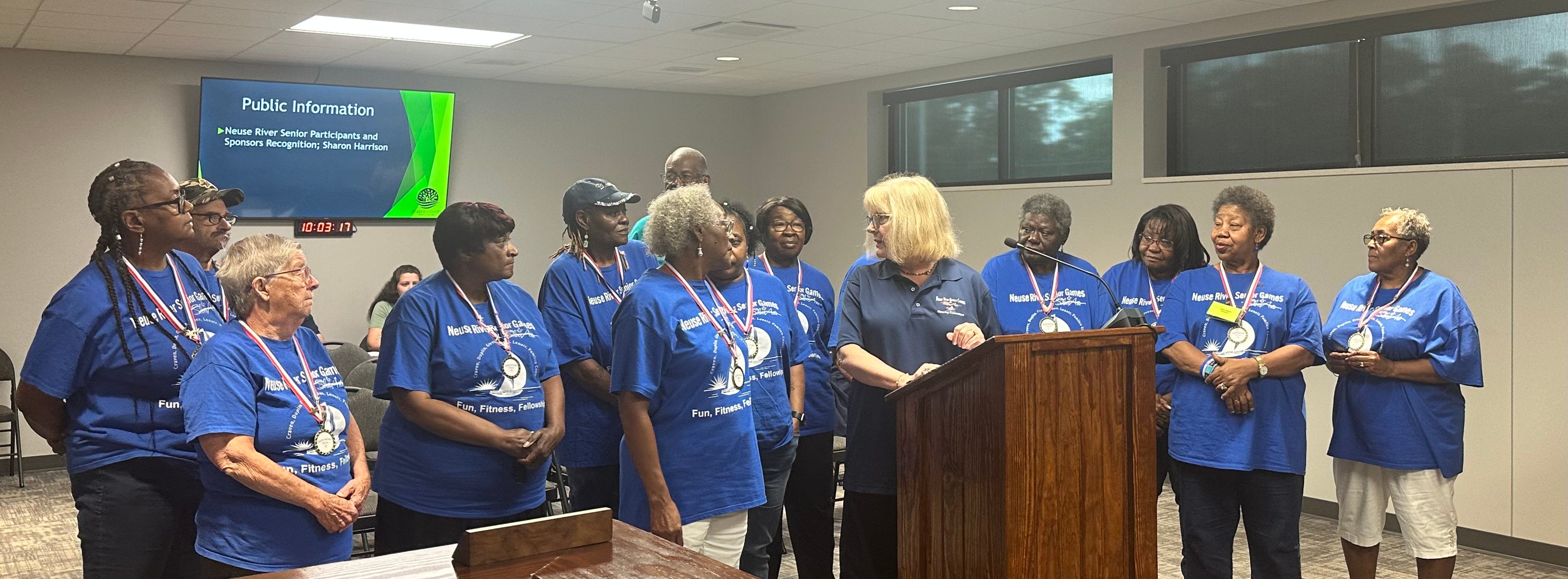
Sharon Harrison, Director of the Greene County Senior Center, opened with a report that briefly lifted the room. Competing against five other counties at the Neuse River Senior Games in New Bern during April and May, Greene County’s 15 participants brought home 25 gold medals, 12 silver medals, and seven bronze medals. Every competitor qualified for the state finals scheduled for September.
Harrison recognized participants by name, drawing applause throughout the room. Among them were first-time competitors Judy Lee and Lisa Davis, along with Bonnetta Collins, who earned a gold medal for a crocheted artwork entry. The strongest response came for Clarence Moore, 86, who earned seven gold medals in track and field events. Harrison also recognized Rosa Jones, Gwen Johnson, Dwight Moore, Mary Shepherd, Nell Chadwick, Alicia Davis, Virginia Thomas, Joan Wade, Annie, and Melinda Waters. Bobby Hodges, 85, competed in the 85 to 89 age group but was not present.
Chairman Heath invited the competitors in attendance to stand for a group photograph with the board before the meeting moved forward.
“Can we officially call you all the gold medal bluebirds?” Heath asked, drawing laughter from the room.
Consent Agenda
Following the recognition, commissioners approved the consent agenda without discussion, including the minutes from the May 4th regular meeting and a releases and refunds schedule involving several vehicle tax adjustments for Greene County taxpayers whose vehicles had been sold or whose assessments required correction.
Budget Hearing and Public Comments
The board next opened the required public hearing on the proposed FY 2026-27 budget. No members of the public came forward to speak. Chairman Heath closed the hearing without discussion and moved on. The public comment period that followed was equally quiet, with no one signed up to address the board.
Closed Session: More Than an Hour, Sheriff Called In
At roughly the six-minute mark of the meeting, following the public comment period, commissioners voted unanimously to enter closed session. The session lasted approximately one hour and fifteen minutes, consuming the better part of the morning.
Near the midway point, Sheriff Matt Sasser, who had been waiting in the lobby area, was called back into the room. Sasser remained with the commissioners through the close of the session.
Katelyn Rouse Reappointed to Board of Health
When commissioners returned to open session, the meeting resumed its normal order. The board worked through the remaining county manager items, beginning with the Board of Health reappointment.
County Manager DeHaven brought forward a recommendation from Health Director Joy Brock to reappoint Katelyn Rouse to the Greene County Board of Health for a second three-year term beginning July 1, 2026. Rouse has been serving as a public member on the board and is eligible for the additional term under board policy. The Board of Health reviewed her application at its May 12th meeting and forwarded the recommendation to the commissioners.
Rouse works as a professor and serves as Communication Committee Chair for the North Carolina Health Information Management Association. In her application, she cited her background in health information and a commitment to ethical, patient-centered care as her reasons for seeking reappointment.
Vice Chairman Jerry Jones moved to approve. “She does a great job,” Jones said. “Glad to have her on the board.” The motion carried unanimously.
Transportation Planning Shifts to Wayne County
The board then took up the Memorandum of Understanding for the Regional RPO, restructuring the administrative home of the Eastern Carolina Rural Transportation Planning Organization. The change became necessary after member counties withdrew from the East Carolina Council of Governments, which had previously served as the RPO’s host agency.
Under the new agreement, Wayne County assumes the role of Lead Planning Agency, taking on administrative and financial coordination responsibilities for the organization. DeHaven explained that Wayne County already employs a transportation planner on staff, a position created in anticipation of potentially taking over the Goldsboro Metropolitan Planning Organization. When that arrangement did not materialize, the position became available to support the RPO function instead. DeHaven characterized the alignment as a fortunate opportunity to put an already qualified planner to work serving the region.
Commissioner Derek Burress asked about Greene County’s matching fund obligation under the new structure. DeHaven indicated the county’s share would remain consistent with prior contributions, noting that the North Carolina Department of Transportation funds the bulk of RPO operations and that DOT has a strong interest in maintaining local planning organizations as a conduit for community input into the state’s transportation project prioritization process.
The four-county organization, covering Duplin, Greene, Lenoir, and Wayne counties and their municipalities, will maintain the same advisory committee structure that existed under the prior arrangement. DeHaven described the new setup as modernized and streamlined for efficiency while functionally close to what was already in place. The board voted unanimously to approve.
Budget Ordinance Removed From Agenda
With the routine business of the morning complete, commissioners reached the final action item on the agenda, the one the room had been waiting for since Heath rearranged things at the outset.
It lasted seconds.
Without discussion, Vice Chairman Jones moved to table the FY 2026-27 Budget Ordinance until the next meeting. The motion passed unanimously. Heath announced briefly that the board would skip the item and take it up at a future meeting. Beyond that brief announcement, commissioners offered no public explanation for the decision.
The budget before the board on Monday was itself the product of months of work and multiple revisions.
When DeHaven distributed his original recommended spending plan to the commissioners at the May 18th meeting, it held the General Fund property tax rate steady at $0.786 per $100 of assessed valuation, the same rate the county has maintained since the 2013 revaluation. That budget was built to maintain services while funding compensation adjustments identified through a recently completed countywide salary study, all without changing the tax rate.
The salary study represented the county’s most comprehensive compensation review in years. Conducted by Becky Veazey of the MAPS Consulting Group, whose findings were presented at the May 27th budget workshop in a session that was recorded and open to the public. The study aimed to bring employee pay to 92 percent of market rates across all departments, address longstanding compression issues that had accumulated over time, and reward employees for longevity and years in position. The goal was to make Greene County competitive with surrounding jurisdictions while maintaining the uniform structure needed to keep salary scales equitable across departments. Getting all of that to fit within the original budget had required department heads to cut their own requests to the bone.
At the May 27th workshop, commissioners directed DeHaven to go back and incorporate a property tax rate reduction into the revised plan.
He did.
The revised ordinance carried a proposed General Fund rate of $0.7835 per $100 of assessed valuation, a reduction of $0.0025 from the current $0.786. On a home assessed at $150,000, the difference amounts to roughly $3.75 per year.
Greene County has held its $0.786 rate since the 2013 revaluation. Following the 2021 countywide revaluation, commissioners chose not to reduce the rate despite rising assessed property values across the county, effectively allowing additional revenue to flow into county operations without a formal rate increase. Available historical records do not show evidence of a countywide property tax rate reduction in recent decades, making the proposed cut, if ultimately adopted, potentially the first of its kind in a very long time.
Achieving even that modest reduction required drawing on fund balance. The revised ordinance appropriated $195,047 from reserves to bring the budget into balance, a figure DeHaven acknowledged was necessary to make the lower rate work and one that underscored the narrow margin between the original proposal and the revised one.
The General Fund totals $27,195,273. Major appropriations include $4.42 million for Greene County Schools, $3.98 million for Social Services, $2.67 million for the Sheriff’s Office, $2.47 million for EMS, $2.45 million for Public Health, and $2.28 million for the jail. Additional appropriations include $1.13 million for Administration, $892,155 for Communications, $595,000 for Public Buildings, $638,079 for Building Inspections, $495,694 for Recreation, $449,792 in transfers to other funds, $409,160 for Emergency Management, $367,974 for Senior Services, $357,939 for Animal Control, $326,378 for Register of Deeds, $288,444 for Cooperative Extension, $267,284 for Elections, $264,000 for Lenoir Community College, and $155,250 for the Public Library.
Beyond the General Fund, the full ordinance spans 36 sections covering special revenue funds for solid waste, transportation, water and sewer operations, school capital finance, emergency telephone services, and eleven separate fire district funds. Fire district tax rates range from $0.07 for the Arba Fire District to $0.122 for the Fort Run Fire District. The landfill tipping fee will rise to $46.00 per ton effective July 1, 2026. The Greene County Regional Water and Sewer System fund is budgeted at $5,046,125, supported primarily by customer charges.
The budget also proposed that employees receive either a 2 percent increase or the result of the salary study, whichever was higher. The salary had focused specifically on the problem of compression: a condition in which long-tenured employees earn the same as, or close to, newly hired employees because cost-of-living adjustments had moved starting salaries upward over time without a parallel mechanism to recognize years of service. The salary study had been a central reference point throughout the budget process. The study has been cited repeatedly in budget discussions as the foundation for countywide compensation adjustments built into the spending plan, but employees said early Tuesday morning that the document itself had not been shared with them.
Taken together, the proposed budget represented months of work, multiple rounds of revision, a long-term compensation strategy, and what may be one of the county’s first meaningful property tax reductions in decades.
Then, in a matter of seconds, and without discussion, commissioners voted unanimously to remove it from the agenda.
For now, the budget remains unfinished, the tax reduction remains only a proposal, and the spending plan staff worked months to prepare remains unresolved.
The ordinance will return.
Commissioner Comments
With the budget pulled from consideration and no further public explanation offered, the meeting turned to commissioner comments. What did not come was any additional explanation of why the budget had been removed.
Instead, the meeting settled back into familiar county business.
Chairman Heath reminded commissioners and the public about the Greene Central High School graduation scheduled for that Saturday at 10 a.m., with the board planning to gather at the school’s media center at 9:30 a.m. He also noted the Town of Walstonburg’s “Proud to Be an American” event scheduled for the same morning, with its main activities running closer to the 11:30 a.m. timeframe.
Vice Chairman Jerry Jones highlighted an upcoming community event before turning the floor over to Social Services Director Amanda Smith. Smith announced that on June 25th at 6 p.m., the Greene County Department of Social Services will host a public town hall at the DSS office focused on food and nutrition benefits, covering policies, research, and the intake process. Jones indicated the board would make the announcement again at the next meeting to help spread the word.
Commissioner Burress thanked David Jones and the Public Works staff for the prompt removal of a sign at the boat landing behind the Courthouse that had been advertising kayaks that were no longer available to the public. Burress had raised the matter at the previous meeting after hearing from constituents confused by the signage. “I was impressed by how fast it was removed,” Burress said.
Commissioner Bobby Taylor raised the issue of illegal dumping and roadside litter, telling the board he had received additional calls over the weekend and that the problem had surfaced at multiple meetings without a clear path to resolution. Taylor asked that the matter be placed directly on the next agenda and said he was open to considering more aggressive enforcement options, including criminal charges, if the civil process continued to move at its current pace.
County Attorney Kevin MacQueen acknowledged that several civil enforcement cases were already working through the courts and noted he had a court date on June 9th and possibly throughout the week before the next scheduled board meeting that would require his attention in the near term. He explained that civil enforcement on litter and property violation cases could take anywhere from nine months to a year or more from initiation to meaningful action, a timeline he had seen firsthand in cases begun around the time he joined the county in April of the prior year that were only now approaching resolution. Several commissioners expressed agreement that more direct tools needed to be considered.
What Comes Next
Greene County now heads into the final weeks before its July 1st fiscal year start without an adopted budget ordinance, an uncommon position for a board that had already completed its workshop process and worked through its major policy decisions in public.
Monday morning had all the signs of a routine conclusion to budget season. DeHaven arrived with a revised spending plan commissioners had requested, a proposed tax reduction built into the numbers, and a public hearing ready to go.
Whatever occurred during the one-hour and fifteen-minute closed session altered that trajectory.
Publicly, commissioners offered only that the item would be taken up at a future meeting. When the board meets again on June 15th, the budget will return carrying more questions than it did at the start of Monday’s meeting. Whether it is adopted as written, revised again, or shaped by whatever conversation took place behind closed doors now remains the central question hanging over Greene County’s budget season.
Disclosure: The author of this report is a member of the Greene County Board of Commissioners. As a participant in Monday’s meeting, the author was present for all open session proceedings described in this story. Consistent with North Carolina law and the ethical obligations governing closed sessions under N.C.G.S. Section 143-318.11, commissioners are reminded at the outset of each closed session that the proceedings are confidential and that members are legally and ethically bound to protect the content of those discussions. Nothing from the closed session has been disclosed or described in this report beyond what was observable from the public record, including the duration of the session, the order in which it occurred on the agenda, and the presence of Sheriff Matt Sasser, who was called from the lobby into the closed session near its midpoint and remained until it concluded.
A Gospel Festival, Rising Rates, and a Mayor’s Warning: Hookerton Tackles It All
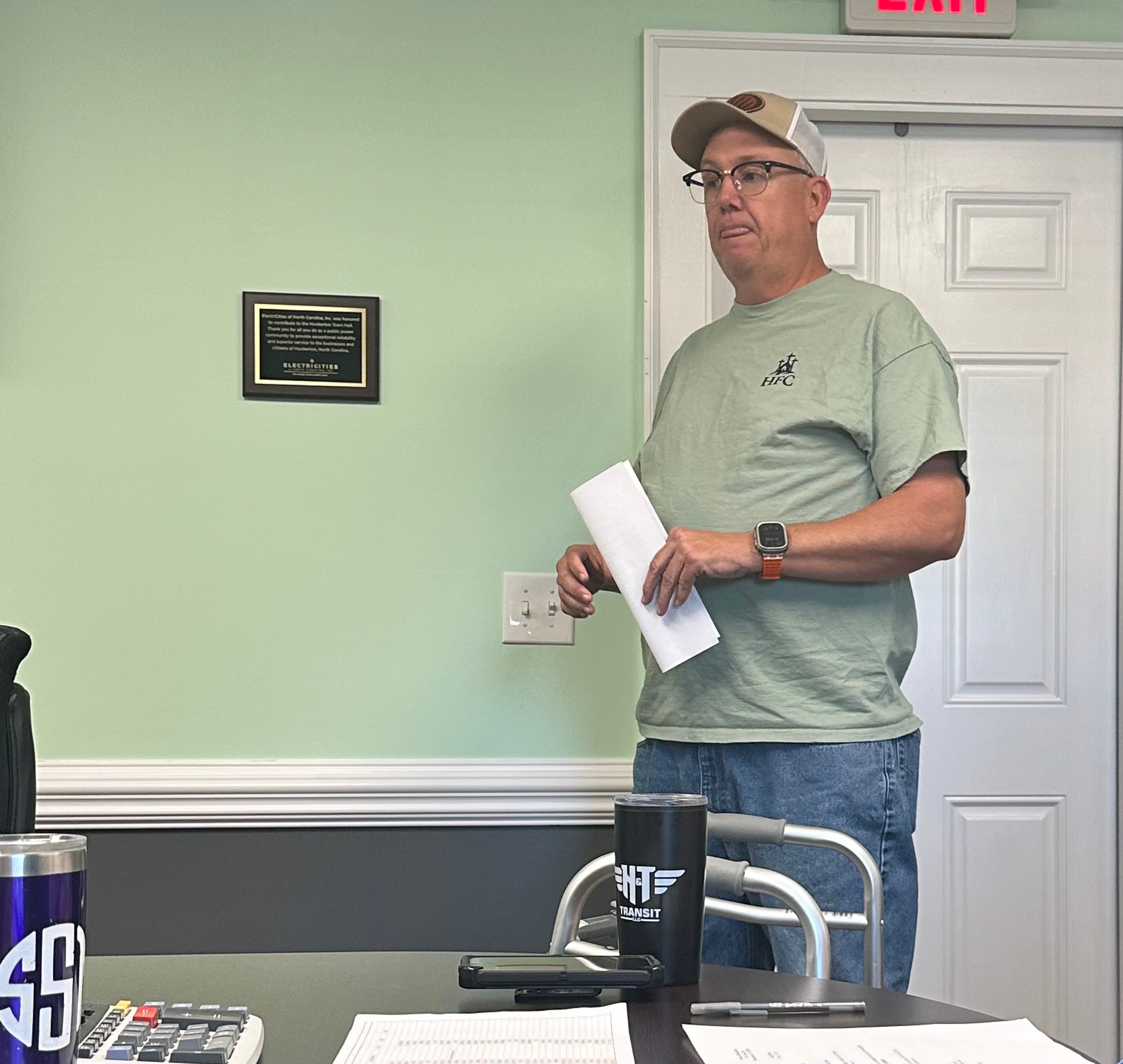
Mayor Bobby Taylor had something on his mind beyond the agenda. When the Hookerton Board of Commissioners gathered on the evening of June 2, 2026, they heard a church leader pitch the biggest public event this small Greene County town has seen in years, wrestled with the unglamorous math of keeping a municipal water system running, and listened as their mayor told them, quietly and without drama, that they may need to carry on without him before long. Commissioner Catherine Carraway was absent.
The Preacher With a Plan
Jeremy Holley did not come to the meeting with a complaint. He came with a dream.
Holley, representing Hookerton Fellowship Church at the old Methodist church building in town, laid out plans for the Hookerton Family Fest, a free outdoor gospel music event scheduled for October 24th that he believes could pull a thousand people or more into Hookerton for a single day. The event would stretch from 11:00 a.m. to around 6:00 p.m., staged on the right side of the church property with a professional stage and sound system, nationally known gospel groups, a Christian comedian, local performers, food trucks, and vendors.
“We’re actually putting between $25,000 and $35,000 into it,” Holley told the board. “We’re hoping to draw at least 1,000 people to Hookerton. I think it’d be great if the town got behind us.”
He already has two major gospel acts confirmed. He said the church has been planning for only two weeks, which made the scope of what he described all the more striking.
Holley was not shy about what he needed from the board. He presented a sponsorship structure: $5,000 for a title sponsor, whose logo would appear on every piece of advertising the event produces, including radio spots, billboards, social media campaigns, and banners; $1,000 for gold; $500 for silver; and $250 for bronze. He told the board the money could come from the current budget or from the new fiscal year starting in July, and he left room for generosity.
“I’m not going to turn money down,” he said. “If you want to donate more than $5,000, we’ll be happy to use it.”
The board quickly got practical. Mayor Pro Tem Sandra Stocks asked about permits. The answer was simple: no special event permits are required, and the only permit needed would be an electrical one for the temporary power connection Holley said the church would likely need. Mayor Taylor made it even simpler. No charge from the town, he said.
Then came the question nobody had a clean answer to: where do you park a thousand cars in Hookerton?
Holley had been eyeing a field behind the church and cemetery and mentioned speaking with the mayor’s son about using it. Taylor stopped him gently but firmly.
“Don’t count on parking back there,” the mayor said. “They’re starting roads back there, and there’s a lift station somewhere in that area.”
What followed was the kind of small-town problem-solving that rarely makes headlines but keeps communities running. Board members began calling out possibilities: a vacant lot near the Jefferson property, a fenced town parcel where a gate might be installed, the parking lots of other Hookerton churches, a shuttle service to move crowds from wherever cars could be left. Holley absorbed all of it without flinching.
“We’ll figure something out,” he said. “We’ve already talked about shuttling people if we need to. Parking is not going to be an issue.”
He added that at previous concerts he organized in La Grange, people drove from Raleigh to attend. One couple came from Indiana.
Mayor Taylor did not hide where he stood. “We need to do all we can,” he said. “You don’t get many folks inside town trying to help do nothing. It’s always outside people that help us more.”
The town’s marquee sign would be made available to promote the event. No formal sponsorship vote was taken, but the room’s enthusiasm was not subtle.
The Unglamorous Work of Keeping the Water Running
If the festival discussion had the energy of a revival, the budget and utility rate conversation had the weight of a long overdue reckoning.
Town Administrator Shawn Jackson walked the board through proposed rate increases set to take effect July 1st, and Public Works Superintendent Tyler Shirley was there to explain why the sewer rates, in particular, could not stay where they were any longer.
“You’ve got $30,000 worth of chemicals that have got to go in once the water gets down to the lagoon,” Jackson told the board. “But the rates have been sitting right together, water and sewer, side by side, for so long, when the cost of running sewer is nothing like the cost of running water.”
Shirley put flesh on the bones. The chemicals alone for the lagoon run close to $30,000 a year, he said. A lagoon motor is currently broken. The last replacement motors he bought, a few years back, cost $7,500 each. A pump at the plant runs twenty-four hours a day, seven days a week, just to keep algae down.
“Sewer is just really, really cheap right now,” Shirley said, and then he gave the board a reference point. After the proposed increase, the in-town sewer base rate would be $34 a month. “The Town of Walstonburg charges $96,” he said. “Just throwing that out there.”
The proposed increases are straightforward. Garbage goes up $0.60 per month, from $18.50 to $19.10, a pass-through of the 4 percent increase the town’s contractor is charging. Water inside town limits increases $1.00 on the base bill, from $30.00 to $31.00 for the first 3,000 gallons, with the rate above that rising from $3.51 to $4.51 per thousand gallons. Sewer inside town limits increases $4.00 on the base bill, from $30.00 to $34.00, with the rate above 3,000 gallons going from $7.50 to $8.50 per thousand. Customers outside corporate limits will see steeper sewer increases, with the base bill climbing from $40.00 to $48.00 and the usage rate rising from $8.00 to $9.00 per thousand gallons. The electric rate holds steady. The property tax rate stays at $0.4465 per $100 of assessed valuation.
For the average in-town customer who does not use more than 3,000 gallons in a month, the combined hit across all three services will be about $5.60.
“Nobody likes rate increases,” Stocks said after the vote, “but nothing is coming down in prices.”
Jackson offered the same plain logic. Everyone sitting at that table and voting on the increases, he noted, lives in town and will pay them just like everyone else. “It’s got to happen,” he said.
Stocks moved to approve the water and sewer rate increases. The motion was seconded and carried.
No Raises, and the People Who Deserve Them
Behind the rate discussion was a budget that left no room for the thing the board clearly wished it could provide.
There will be no pay raises for town employees this year.
Jackson and Shirley said it plainly, and neither tried to dress it up. The numbers do not support it. The general fund for the coming year sits at $417,770. Insurance costs are climbing. Chemical prices are up. And the town is not in a position to add payroll expense on top of everything else.
“I just don’t know where to get it,” Jackson said.
Stocks did not let the moment pass quietly. “I feel like we failed our employees,” she told the table, looking toward Jackson and Shirley, “to include you here at this table. I don’t believe in getting a pay increase just because you put in another year. But if it was earned and we can’t afford it, that’s hard.”
Jackson offered one option that would not touch the budget: give employees a few additional paid days off, discretionary time they could take with supervisor approval. Three days cost the town nothing extra in cash, he said, but it is something. Christmas bonuses and existing benefits remain in place. Hourly rates hold where they are.
The board agreed to hold the required budget public hearing on Tuesday, June 23, 2026, at 6:00 p.m. at the Hookerton Town Office.
The Mayor’s Quiet Word at the End
Before the meeting closed, Taylor mentioned that word had reached him of a potential donation to the town, possibly campaign funds being returned by a departing elected official, though he had not yet confirmed any details.
Then he said something else, and the room went still for a moment.
Taylor told the board that his health may keep him away before long, possibly back in the hospital, and he did not know what was coming. He asked them simply to carry on if he was not there.
“If I’m not here, take care of the problems and let’s move on,” he said.
He did not linger on it. The meeting adjourned shortly after.
The Day I Learned that I Speak Turkey fluently
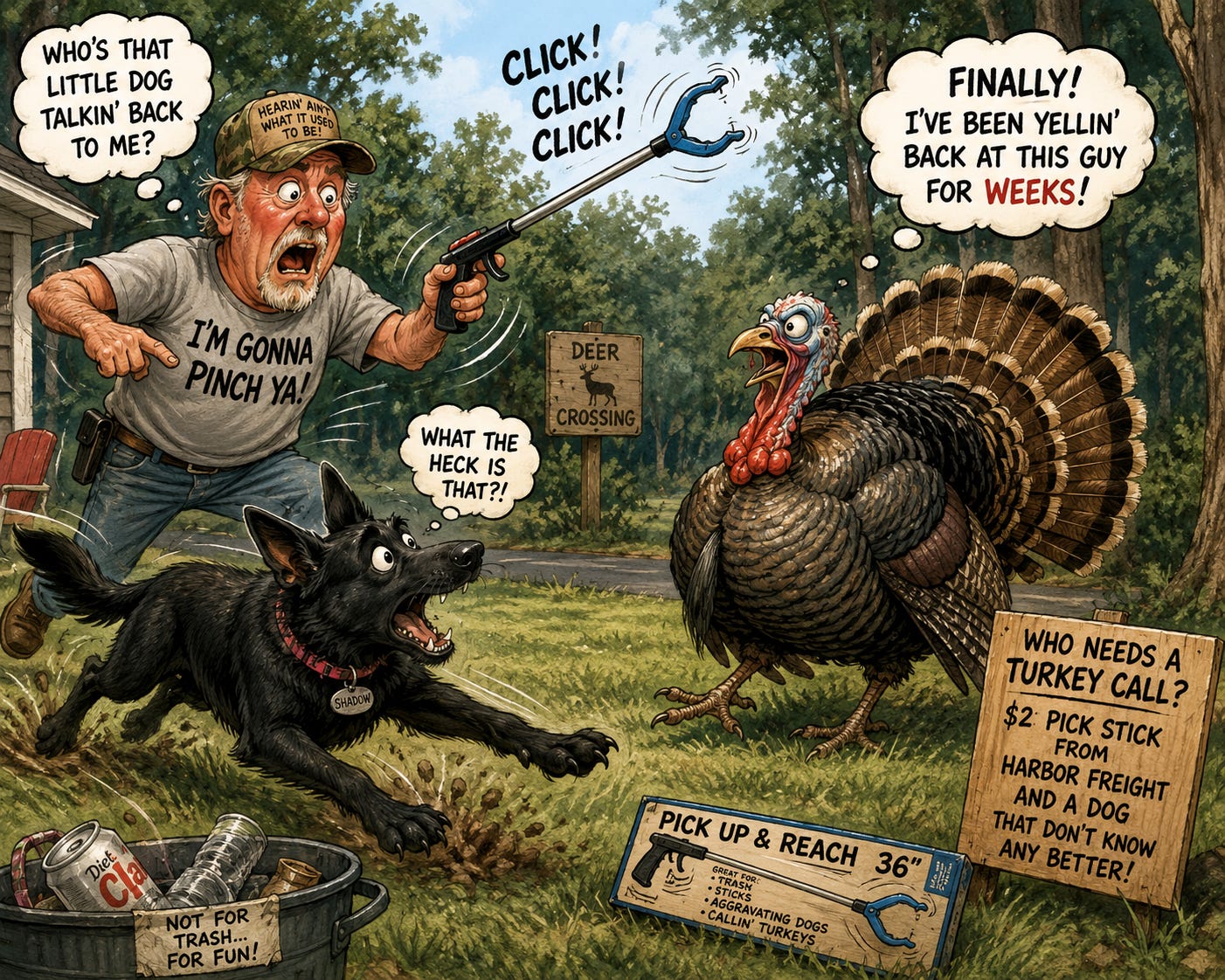
Well, I never intended to become some kind of turkey whisperer. Truth is, I bought one of those pick sticks because my knees have reached the age where every time I stand up, they make sounds like somebody stepping on a bag of potato chips.
You know the kind I’m talking about. Those grabber things people use to pick up trash in the yard or along the road. Normal people use them for picking up cans.
I use mine for chasing my dog.
Every evening we’d head out in the yard, and I’d grab my trusty pick stick and start clicking that thing together while chasing her around, hollering, “I’m gonna pinch ya!”
Click click click.
The dog would go tearing across the yard at full speed while I’d follow behind, making enough racket to sound like two skeletons fighting over a coffee can full of bolts.
After a while, I started noticing something strange. Every time I’d get to clicking and carrying on, I’d hear what sounded like a little dog barking from somewhere across the road near the woods.
At least I thought it was a little dog.
Being hearing-impaired, it’s sometimes hard to tell the difference between a tiny dog, a squirrel having an emotional breakdown, or somebody backing over a squeaky toy.
So naturally, I figured somebody nearby had themselves a little yap dog that apparently wanted to join our evening activities.
The weird part is that my dog always reacted to it. Every time I’d hear the sound, she’d stop dead in her tracks, tilt her head, and stare toward the woods like she was trying to solve a murder.
Meanwhile, I’m still out there doing my important work.
Click click click.
“I’m gonna pinch ya!”
Response from woods.
Click click click.
Response again.
This went on for weeks.
Weeks.
Without me realizing, I’d apparently entered into some long-distance friendship with wildlife.
Then one evening everything changed.
I’m out there chasing the dog around the yard like usual. I’m clicking away with the pick stick like a man possessed. The dog is running. I’m running. The neighbors are probably standing at the window wondering if they should call somebody.
Then suddenly I hear the response again.
Except this time it sounds close.
Real close.
The dog freezes.
I freeze.
We slowly turn toward the woods.
And out from the edge of those trees comes the largest wild turkey I have ever seen in my life.
This thing wasn’t casually walking either.
No sir.
This turkey came marching out looking like he’d finally gotten tired of yelling across the road and decided to come see who exactly had been sweet-talking him for the last month.
The dog looked shocked.
I looked shocked.
The turkey looked disappointed.
Like he was thinking, “Wait a minute. THIS is what I’ve been talking to?”
My dog immediately started barking and headed toward it.
The turkey puffed up.
I considered my options.
Then I discovered I can still move surprisingly fast when being judged by an angry bird the size of a folding chair.
Turns out all those weeks I hadn’t been calling somebody’s small dog.
I had accidentally been calling in a wild turkey.
People spend money on expensive turkey calls, camouflage, decoys, and hunting gear.
Meanwhile, I accidentally discovered you can apparently achieve similar results by buying a two-dollar pick stick from Harbor Freight and running around your yard harassing your own dog.
Save your money, folks, and pick up a cheap pick stick at Harbor Freight the next time you ride over. There is no need to buy a new turkey call next season when a two-dollar pick stick will do the same job, if not better!